Anni prototypes 2020
The Anni prototypes 2020 were Audiopoli R&D experiments in search of a bigger successor to the Aniversario speaker. The goal was a speaker that sounds as close as possible to the original Anni but extends the reproduction lower and can handle more. The prototypes did not lead to a member project.
The experiments were carried out in brainstorming and design evenings. The enclosures were modelled with Fusion 360 and milled at the Aalto Fablab.
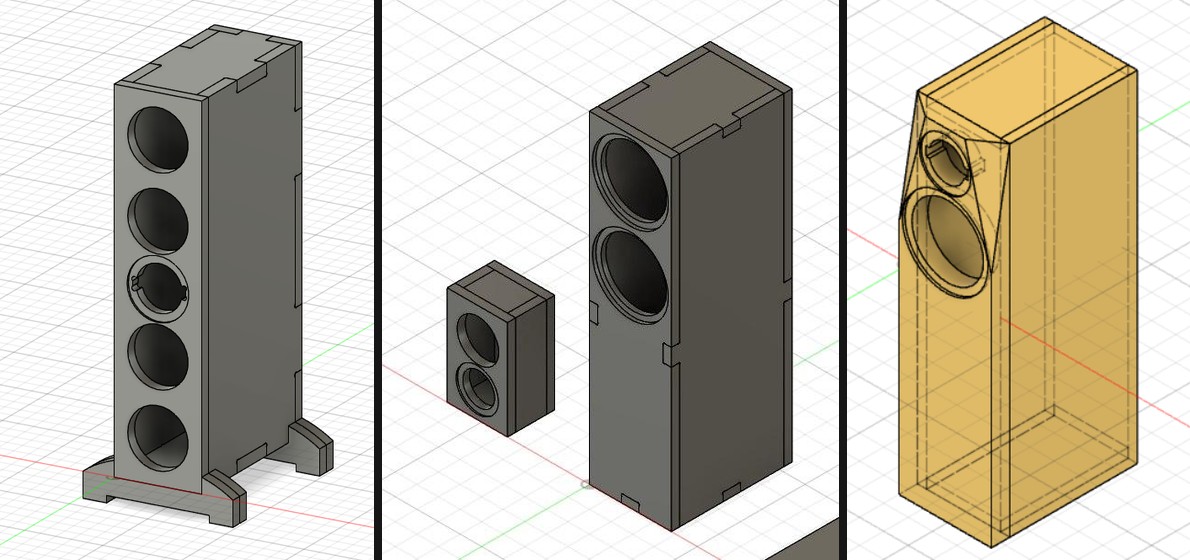
Prototype enclosures modelled in Fusion 360: the Quad Anni (left) and other enclosure options
The ideas
There were several ideas: the Quad Anni (an Anni with four woofers), the 6.5-inch Anni, where the original woofer is replaced with a SEAS 6.5-inch woofer (a cheap or an expensive option), bass stands for the Anni or for new Annis, and small sealed mini Annis. Bass stands had already been experimented with earlier, see Anni bass stands.
The Quad Anni
The four-woofer Anni was built and taken to a test listening. It worked well compared to expectations and clearly handled more than the ordinary Anni: the −6 dB point was measured at 38 Hz. Below that, however, the reproduction disappeared quickly, and the speaker probably isn't worth its price, since an ordinary Anni plus a subwoofer would probably give a better result for less money. The Quad Annis were left at that: they were a fun experiment.
The 6.5-inch Anni
Enclosures were built with SEAS's cheaper (L18RCY/P) and more expensive (Excel W18E001) 6.5-inch drivers. After adjusting crossovers, measuring and listening, the Excel driver was found to be clearly better: the cheaper driver sounded over-bright, even fizzy, and lacked bass.
Preliminary settings for the Excel Anni:
- Woofer: SEAS Excel W18E001, low-pass at 2,500 Hz (Linkwitz–Riley, 12 dB/oct) plus a 4,900 Hz notch of −16 dB (Q = 4)
- Tweeter: SEAS 22TAF/G, high-pass at 3,000 Hz (Linkwitz–Riley, 12 dB/oct)
- Enclosure: 10-litre ported enclosure, tuned to 40 Hz
The experiments also showed that Reckhorn bass stands don't benefit the 6.5-inch Anni: the speaker already reaches so low by itself that integrating a stand only muddles the bass reproduction.
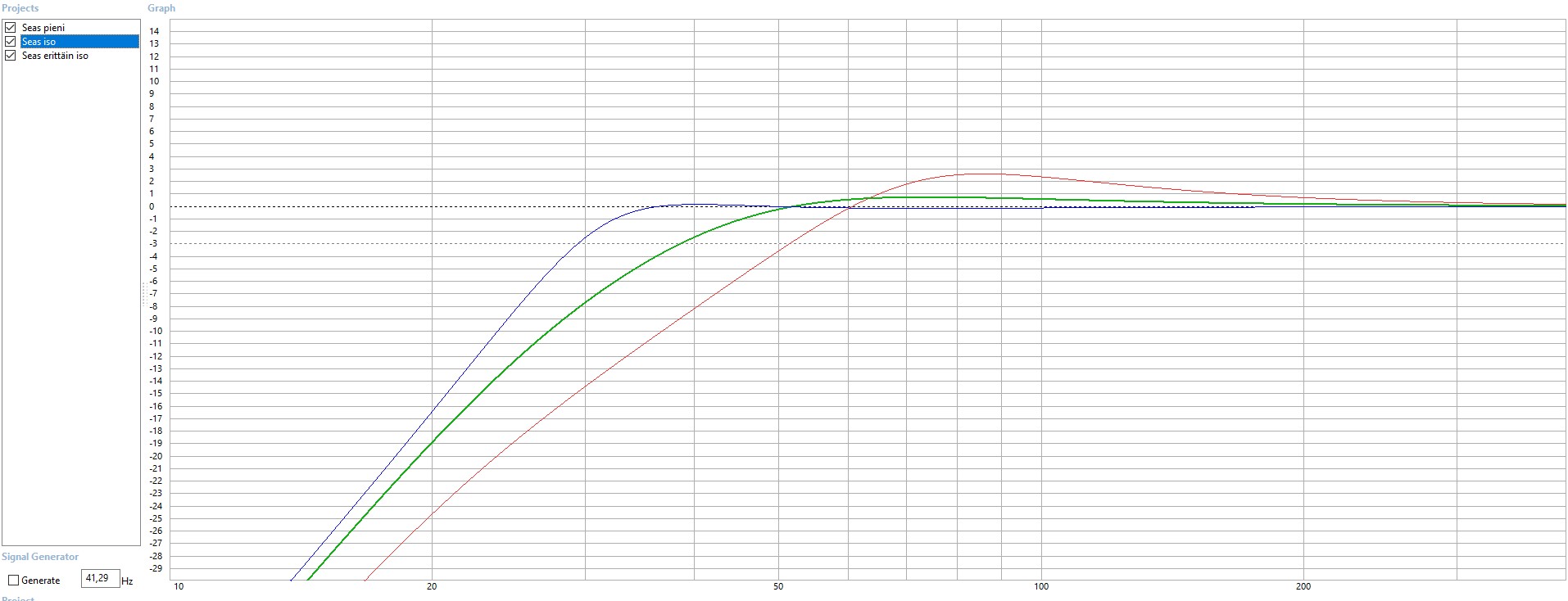
Modelling of three enclosure options. By increasing the enclosure size and lowering the tuning, the response extends much lower: 10 l / 45 Hz, 20 l / 35 Hz and 40 l / 32 Hz.
Crossovers and diffraction
In the first experiments the active crossover was done with a miniDSP 2x4HD. Later the work moved to designing a passive crossover with the xSim software: the frequency responses of the drivers are measured individually and in parallel, along with their parameters, which makes designing a passive filter easy.
Measurements and listening revealed that the wide front panel diffracts high frequencies. It causes small problems in the response and weakens the stereo image significantly. Rounding the edges of the front panel helped only a little, but the problem was properly fixed when pieces of Kinopoli's floor carpet were taped to the front panel. Later felt was found to do the same. A fun side note: the association's pink furry Annis may be the most hi-fi Annis ever made, because the pink fur also damped the diffraction. For the next prototypes the plan was to try a harder shaping of the front panel, so that no damping material would be needed.
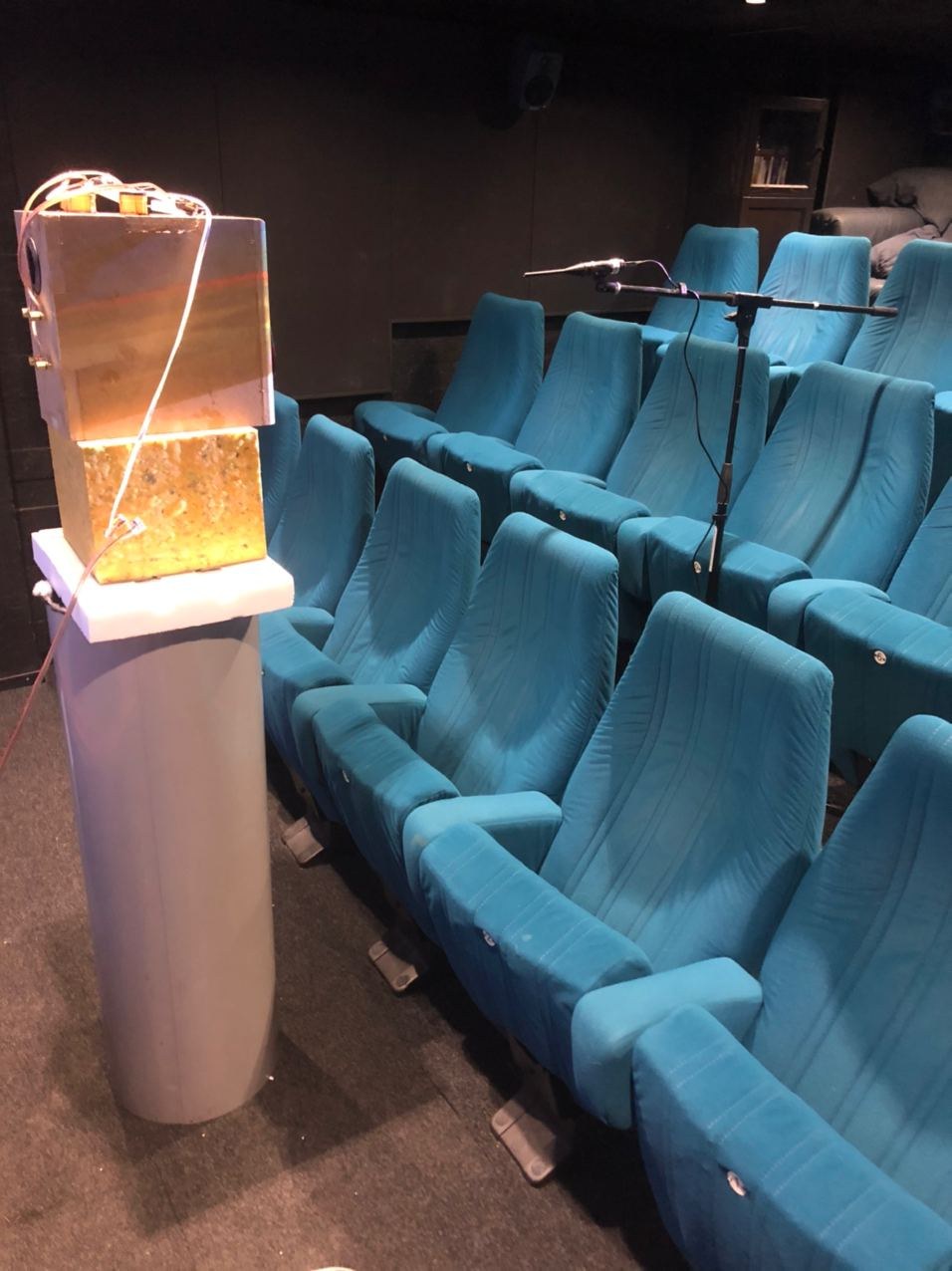
The measurement setup in Kinopoli: a speaker on a stand and a measurement microphone
The A/B test
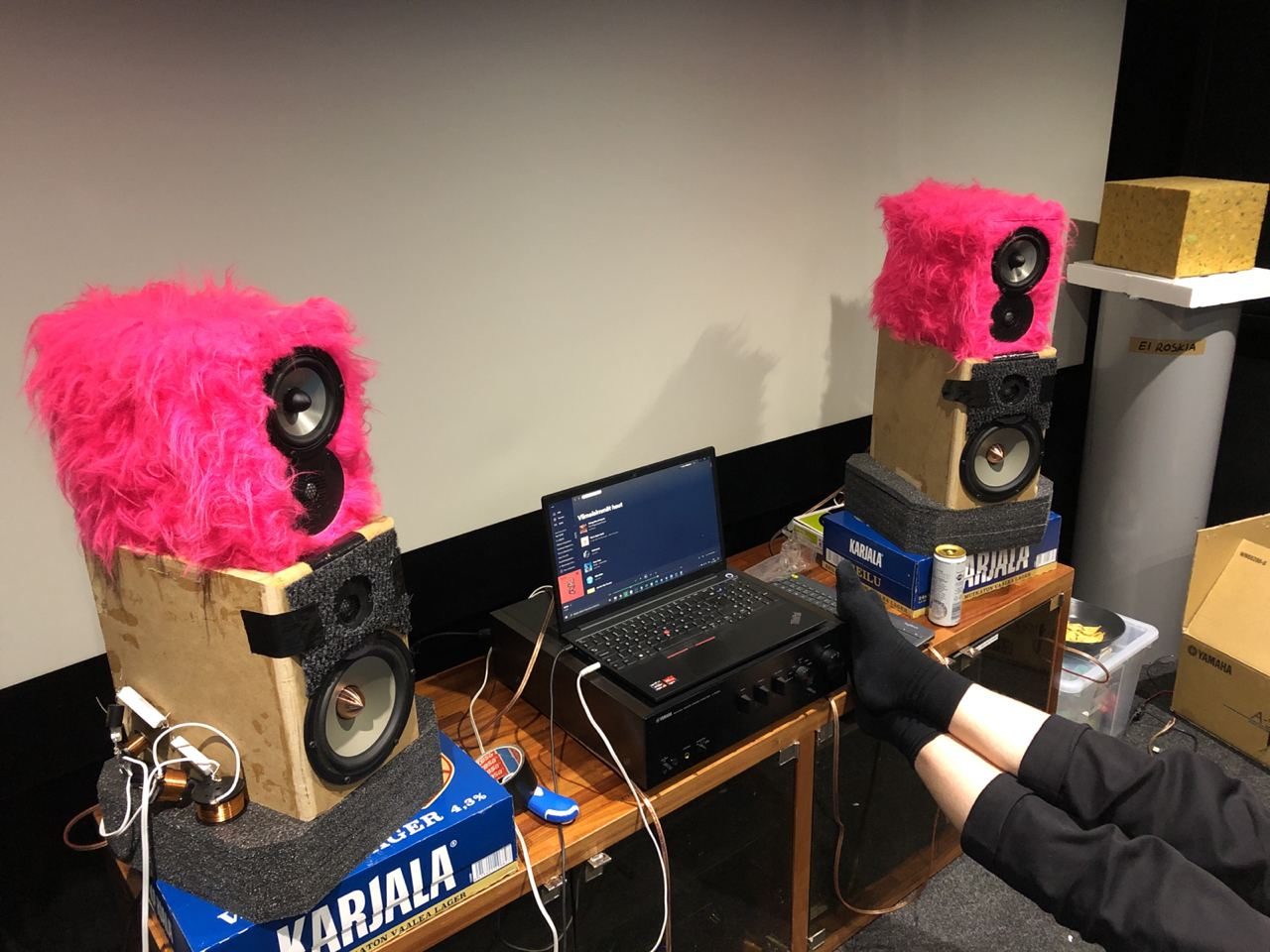
When the prototypes were taken to the Kinopoli side for a test listening against the original Annis (the listening setup is visible in the picture at the top of the page), the result was unanimous: the Excel Annis beat the ordinary Annis. The Excel Annis' bass was clearly more solid and deeper, as was intended, but the treble and midrange were also much better. Many songs sounded somehow compressed on the ordinary Annis, while on the Excel Annis the sound seemed to "open up" to a wider area. Natural sounds such as vocals, guitar and piano also sounded more natural on the Excel Annis.
Next steps
Improving the tweeter became the next theme: although the Anni's SEAS 22TAF/G sounds good, problems were found in it too in the measurements. A SEAS 27TBCD/GB-DXT, which has a small waveguide to control diffraction and directivity, and a Dayton Audio AMT2-4 ribbon-type tweeter were ordered for testing. New enclosures were built at the same time, including a stand-mount model and a 34-litre floorstanding model with interchangeable front panels. The floorstanding model worked very well.
As a side experiment, DML speakers (distributed mode loudspeakers) were built from Finnfoam board and Dayton Audio Ultra exciters. The result was interesting, but not very pleasant without heavy equalisation.