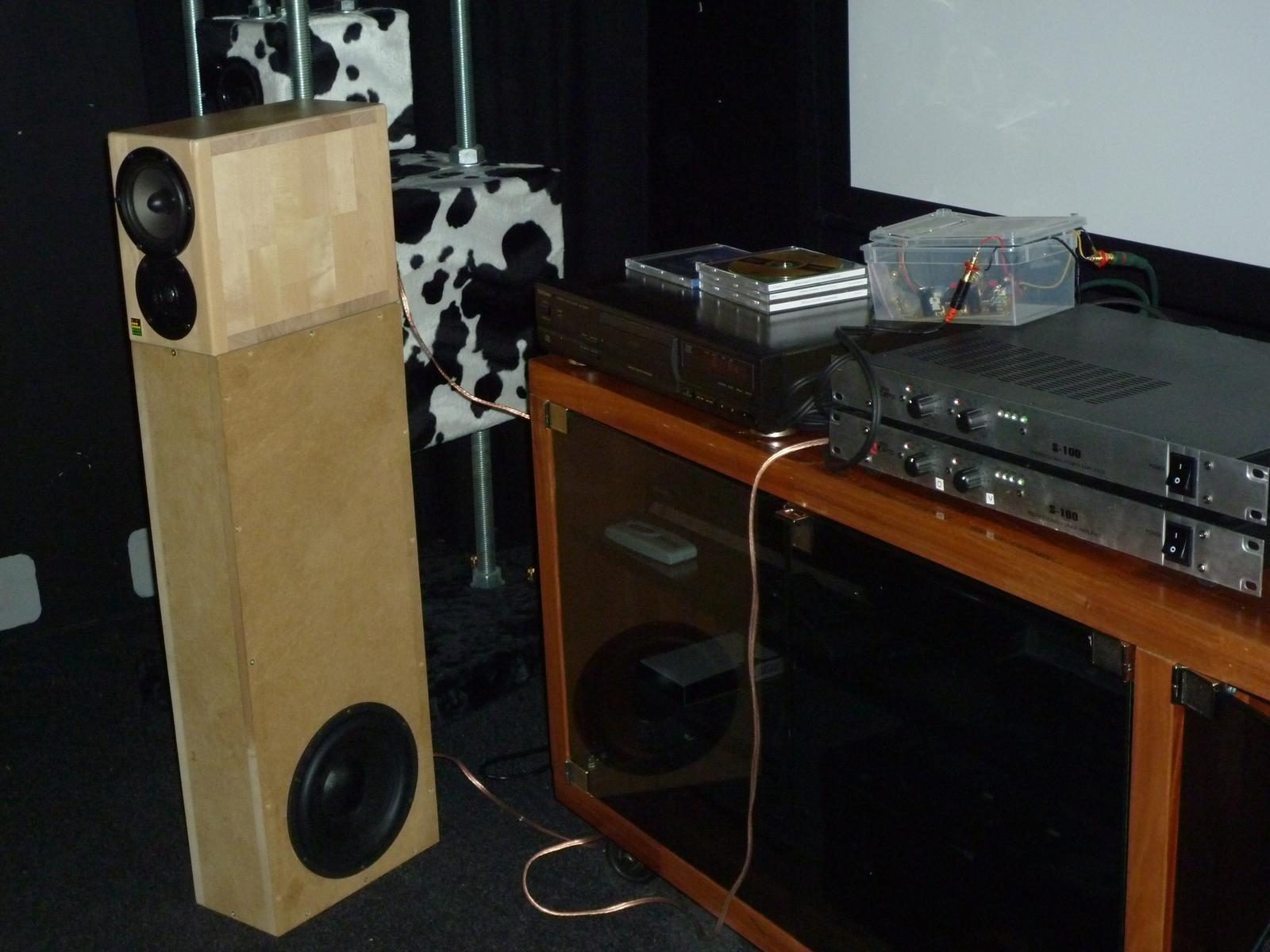
Anni bass stands
The Anni bass stands were an Audiopoli research and development project in 2009–2010. The goal was to design bass stands for the Aniversario loudspeakers: a subwoofer tower of the same width that fits under the Anni and extends the reproduction lower. The project got as far as prototypes and a fair demo (pictured: an Anni on top of a bass stand prototype), but was eventually put on ice when the chosen woofer was taken out of production by its manufacturer.
Starting points
- The Anni is 14 cm wide, 23 cm tall and 28 cm deep, so the stand has to be the same width and form a continuous column with the Anni. A stand one metre tall made of 19 mm board would have an internal volume of about 18 litres.
- The Anni's woofer is tuned to about 60 Hz.
- The lower limit of the reproduction band was set at about 30 Hz, and the upper end so that the distance between the drivers doesn't yet cause problems. The drivers radiate in all directions, so the driver's distance from the Anni matters.
- The target for a kit price for a pair was under 400 euros.
The driver had to be easy to obtain, and since the stand is only 14 cm wide a very deep driver couldn't be used: a depth of at most about 12–13 cm, and at 28 cm depth at most a 10-inch driver fits.
Drivers and operating principle
Driver options were compared by modelling: they included the Peerless SLS and XLS series, the TangBand W8-740E, the Wavecor SW178WA01 and the CSS SDX7. The comparison was made with 16–17 litre enclosures, and in the end the Peerless 8-inch SLS looked the most promising.
Reflex, passive radiator and sealed enclosure with electronic correction were compared as operating principles. A reflex is easy and cheap, but tuning an 18-litre enclosure to 30 Hz with an 8 cm port would need a port about 87 cm long, which would take up too much space. A sealed enclosure would fit in a small space, but would need a large cone area, a lot of power and equalisation.
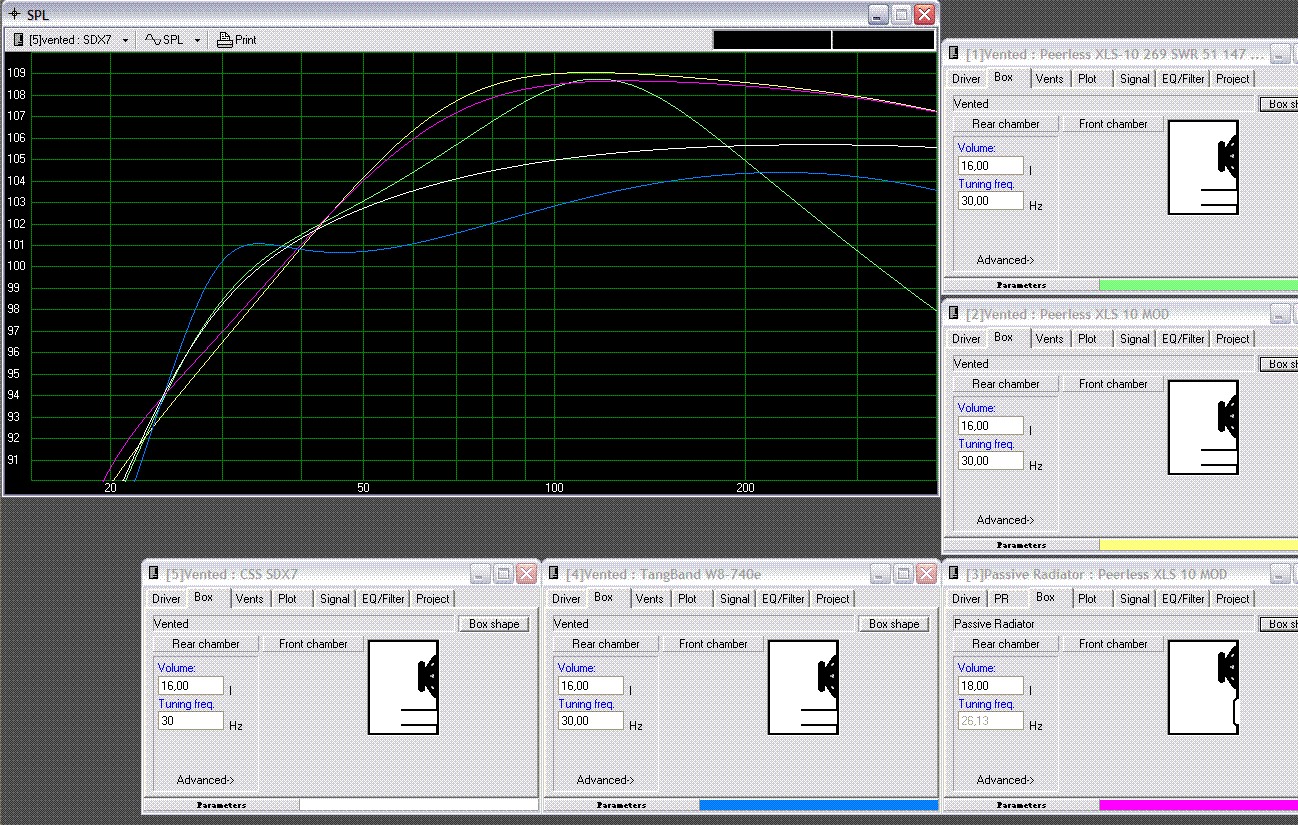
Simulating candidate drivers: 16-litre enclosure, tuned to 30 Hz
The crossover: active wins
An ordinary passive crossover turned out to be too expensive. A second-order low-pass filter at a 100 Hz crossover frequency would need, for an 8 ohm load, a coil of about 18 mH and a capacitor of 140 µF, and the components would cost about 50 euros per enclosure. So an active crossover was chosen.
Audiopoli members designed their own analogue active crossover, built with operational amplifiers. The circuit boards were etched at home, and an assembly guide was written for the crossover, including separate extra instructions for a homemade circuit board without plated-through holes. As the amplifier, options such as chip amplifier kits and a ready-made subwoofer amplifier were considered, since nobody wanted to fiddle with mains voltage.
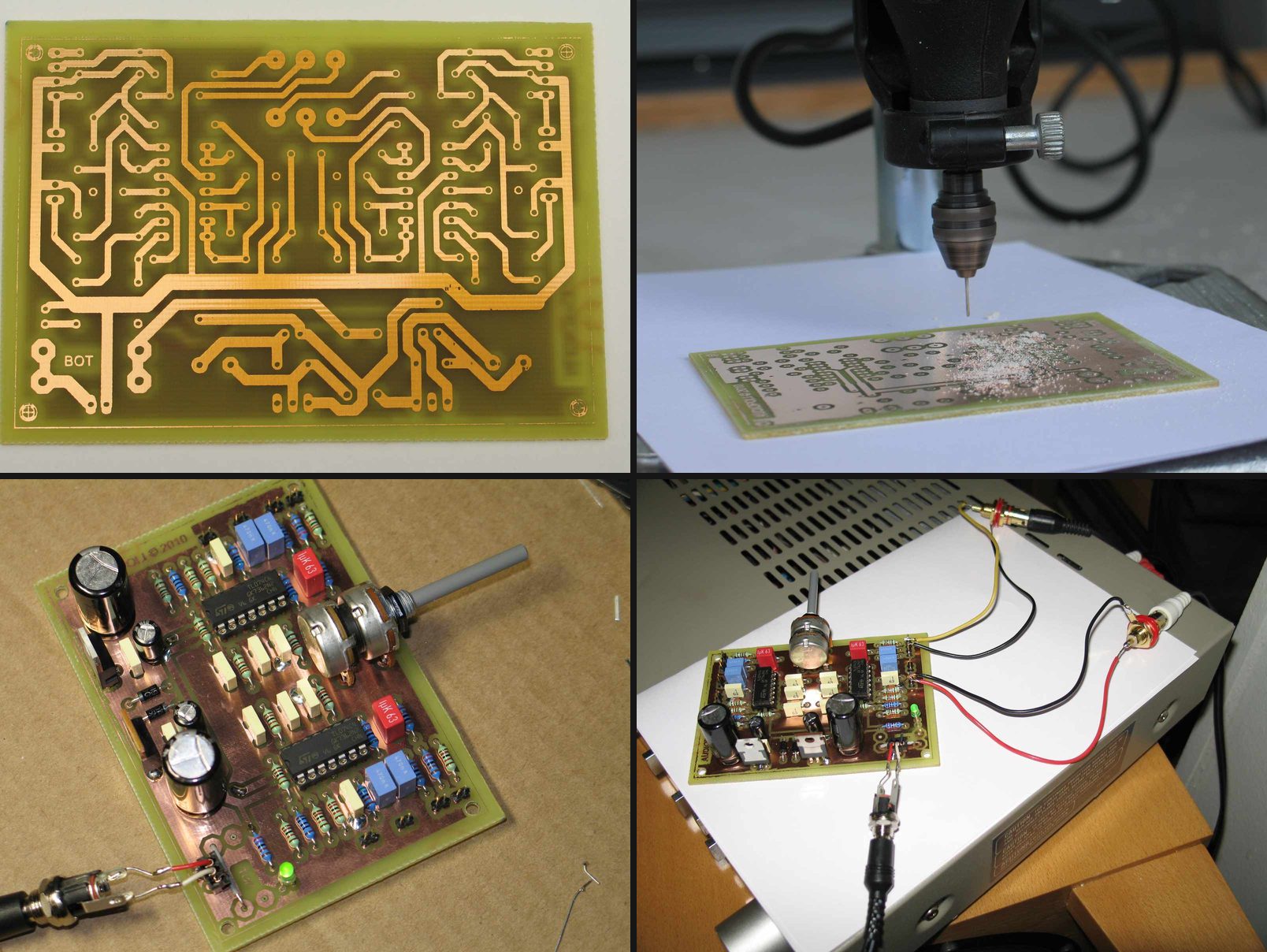
The homemade circuit board: the finished copper pattern, drilling the holes, the finished board and a trial connection on top of an amplifier
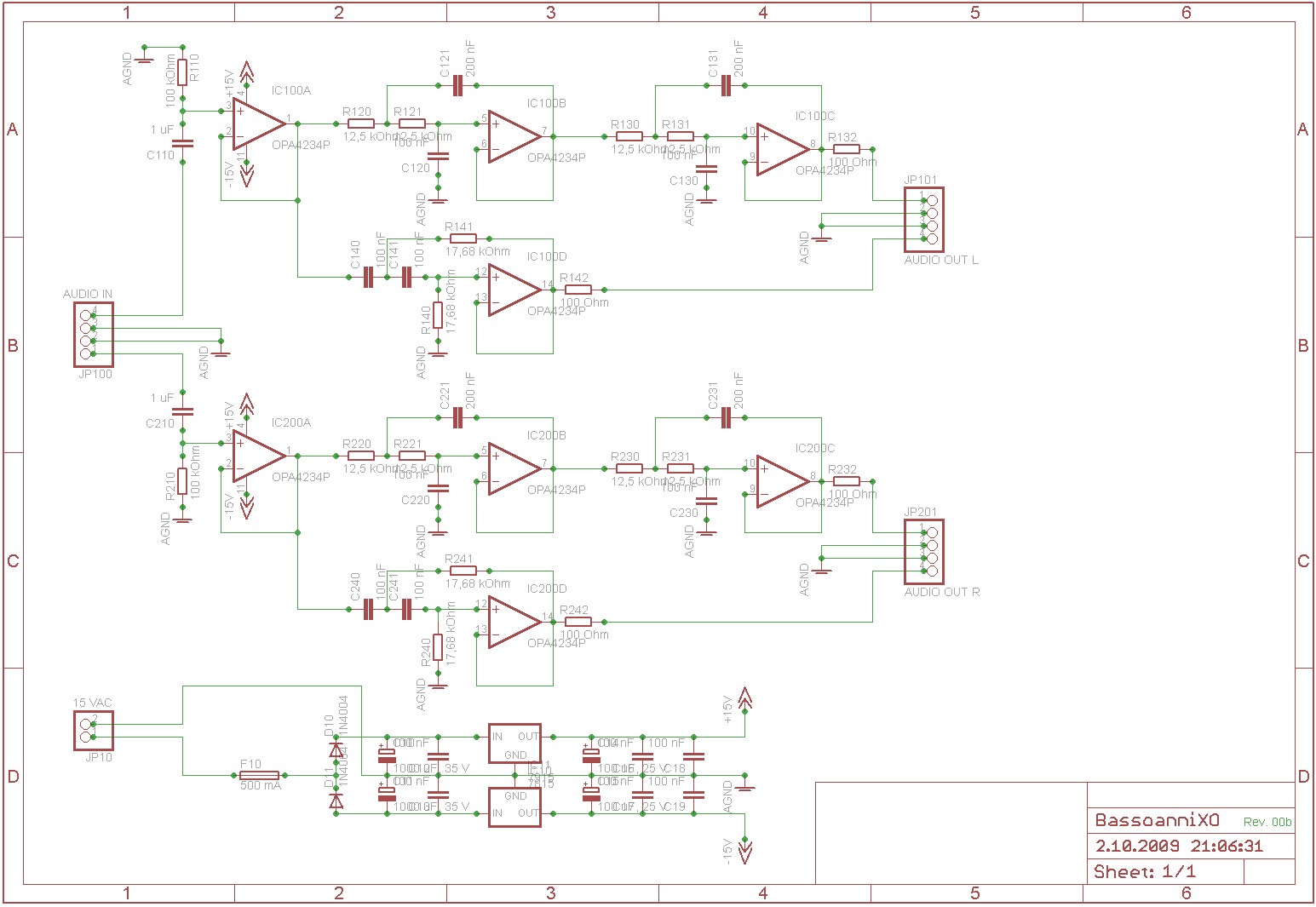
Circuit diagram of the active crossover
The design process
The project's design and measurement process went as follows, and it can be used as a template for your own speaker projects:
- Modelling based on the drivers' parameters.
- Designing and assembling a prototype enclosure. Long walls need bracing, and the shape of the port tube has to be designed, since a straight tube is impossible because of its length.
- Measuring the drivers in the enclosure: frequency response from 0, 15, 30, 45 and 60 degrees, distortion at different sound pressure levels (e.g. 90, 95 and 100 dB) and the impedance response. The phase should be measured carefully, otherwise the simulations go wrong at the crossover frequency.
- Modelling the crossover based on the measured frequency and impedance responses, which gets you close to the final result.
- Testing and listening. Testing is easiest with a DSP crossover, which can make the same splits as the final filter and whose parameters are easy to change. If you don't like the result, go back to steps 1–4.
- Designing the analogue filter based on the final parameters.
Outcome
The prototype enclosures were completed in autumn 2010, and the crossover was finished on the opening day of HifiExpo 2010. The stands were demonstrated at the fair, and they attracted a good amount of interest. The sound of the stands was praised. The speakers' responses were measured on 14 October 2010.
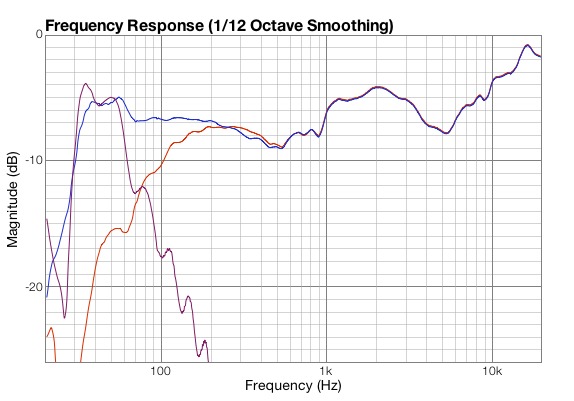
A measurement of the response of the bass stand and the Anni, 14 October 2010
When the project was being started up, it turned out that the manufacturer had just discontinued the chosen woofer. No direct replacement was found, so the project was put on hold for the time being. The subject was returned to in 2020, see Anni prototypes 2020.